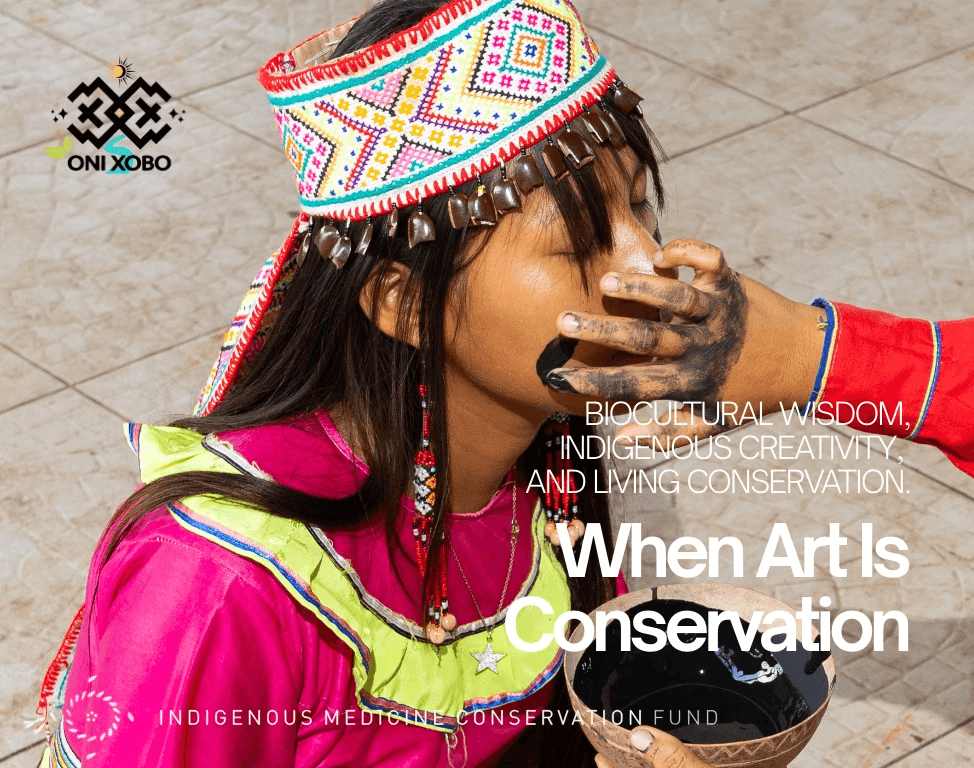

When Art Is Conservation: Biocultural Wisdom and Indigenous Creativity
By the Indigenous Medicine Conservation Fund
On a hot afternoon in Yarinacocha, a group of 24 young Shipibo dancers take the stage.
Their movements are ancient and coordinated, learned through months of practice in rural schools along the Ucayali River. Clothing and textiles display kené designs, a form of artistic expression passed down through generations, rooted in Shipibo history, place, and worldview. Around them, families, elders, and visitors gather in an urban setting to witness something deeply local and profoundly alive.
You saw it here first: A look inside Oni Xobo's Festival Tari, where Shipibo youth share in dance, song, and cultural exchange in Ucayali, Peru. Video clip part of a longer mini-documentary produced by Oni Xobo during the second Festival Tari in 2024.
This is Festival Tari, a cultural song and dance festival organized by Oni Xobo. The festival creates space for Shipibo youth to practice, share, and celebrate their culture through dance, song, poetry, and visual art. It also offers a broader picture of Shipibo life. For many outsiders, particularly Western visitors, engagement with Shipibo culture often centers almost exclusively on Ayahuasca. Ancestral medicine practices are incredibly special and important, but they exist within a much wider cultural ecosystem that is normal to community members and a lot of the time, not seen by outsiders. At Festival Tari, that cultural ecosystem is visible and embodied. The dances themselves tell stories — of rivers, animals, customs, ancestors, and the responsibilities that come with belonging to a place.
Seen through a biocultural lens, Festival Tari is not only a cultural event. It is itself a form of conservation.
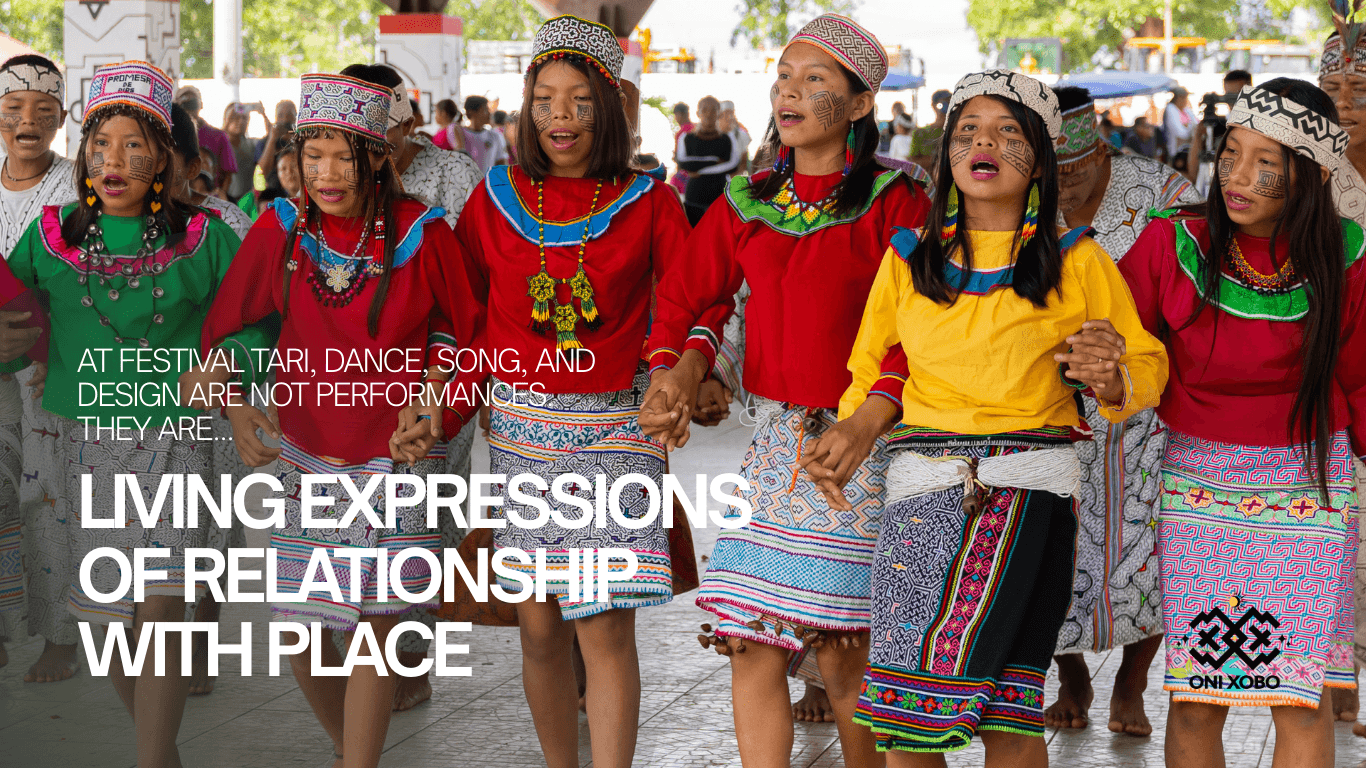
Young Shipibo dancers at Festival Tari in 2024.
Rethinking Conservation Through Culture
Mainstream conservation has often approached environmental protection through technical tools: protected areas, species monitoring, regulatory frameworks, and data-driven management. Culture, when acknowledged, is frequently treated as background context or as a means of communicating conservation goals to local communities.
For many Indigenous Peoples, however, the separation between nature and culture simply does not exist.
A growing body of interdisciplinary research supports this understanding. We recently had the pleasure to read a particularly compelling contribution by Tsuji and Johnson, who wrote the chapter Biocultural Ontologies, Art, and Conservation, published in Linking Arts with Biocultural Conservation, Restoration, and Communication as part of book series on Ecology & Ethics. The authors were generous to share with us so we could read it. Their work challenges the assumption that conservation is primarily a scientific or managerial activity and instead argues that, in many Indigenous contexts, conservation is inseparable from cultural and artistic practice. This is the same approach that the Indigenous Medicine Conservation Fund takes, and it is why we were interested in reading the chapter.
From this perspective, art is not something that represents nature from a distance. It is a way of engaging with the living world directly, maintaining relationships with lands, waters, plants, animals, and ancestors over time.
Biocultural Ontologies: A Different Way of Understanding Life
Tsuji and Johnson use the term biocultural ontologies to describe worldviews in which biological, cultural, and spiritual dimensions of life are fundamentally intertwined. Ontology, in this sense, refers to how reality itself is understood: what exists, how beings relate to one another, and what it means to live and live well.
Within many Indigenous ontologies, humans are not positioned above or outside nature, but within it. Knowledge is not limited to written texts or abstract data, but is embedded in lived practice, where art plays a central role. Songs, dances, designs, and stories are ways in which knowledge is remembered, practiced, and passed on. They help orient people within their territories and remind communities of the responsibilities that come with relationships.
This understanding aligns closely with the biocultural conservation approaches supported by IMC Fund, which recognize that ecological wellbeing and cultural continuity are mutually reinforcing.
Art as a Way of Knowing
One of the key insights of Tsuji and Johnson’s chapter is the insistence that art should be understood as a form of knowledge rather than as decoration or symbolism alone.
In many Indigenous societies, artistic practices carry detailed ecological and social understanding. Songs may reference seasonal changes or animal behavior. Dances may recount histories tied to specific landscapes. Visual arts such as weaving, carving, or embroidery require intimate familiarity with materials sourced from local environments and are shaped by long-standing cultural protocols.
Kené, for example, is one such form of cultural expression within the Shipibo culture. Like song and dance, it is learned over time through observation, practice, and teaching across generations. Its significance lies not only in its visual form, but in its role within a broader cultural system that includes medicine, ceremony, and social life. Shipibo kené designs are recognized as a National Cultural Heritage of Peru (as are their Ikaros), but the significance of the millenary designs transcends recognition by the state.
Young people learn these practices in their families (and in recent times, in intercultural schools), and in doing so they are learning how knowledge has been carried, how relationships are maintained, and how cultural continuity supports the health of their communities and their territory.
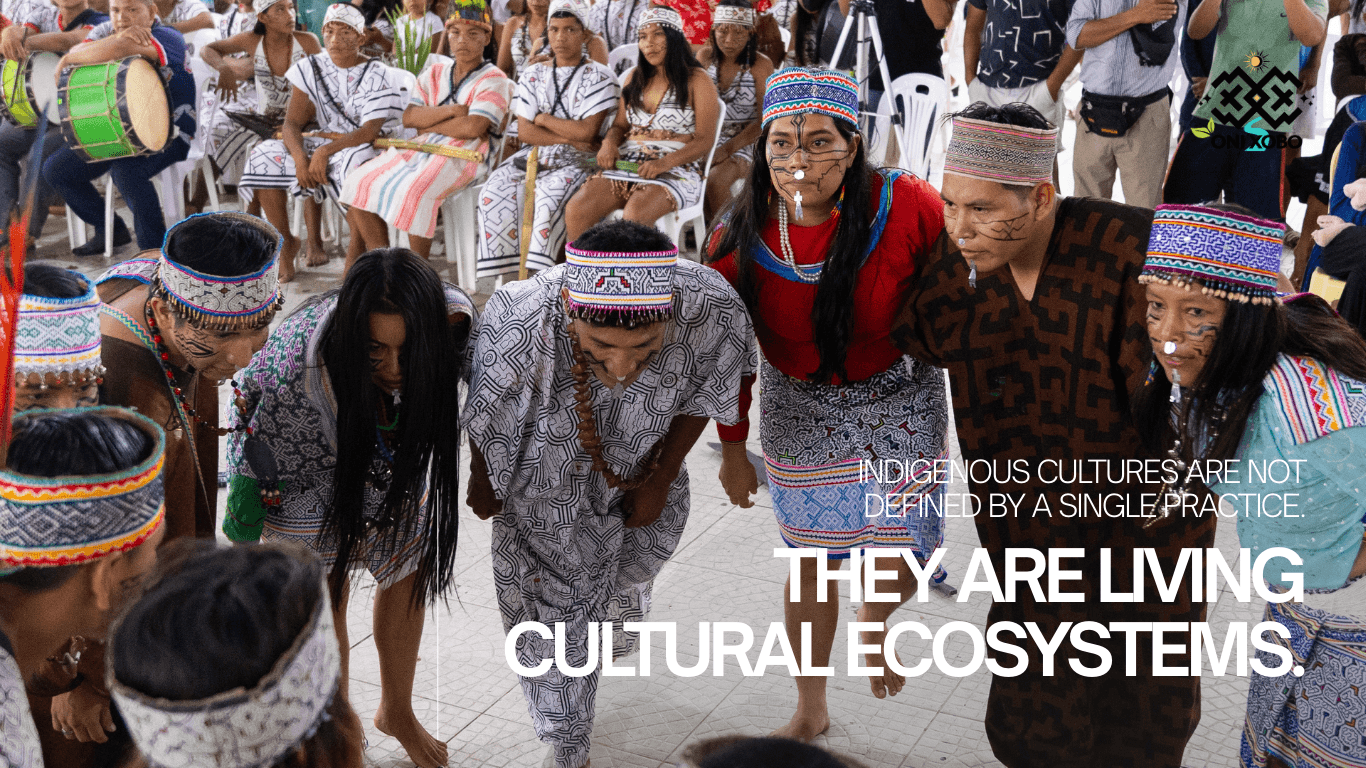
Oni Xobo's in-house dance group performing a traditional dance at Festival Tari in 2024.
What Is Lost When Art Is Disrupted
The chapter also draws attention to what happens when artistic practices are interrupted or devalued. Cultural disruption, whether through displacement, assimilation pressures, or economic marginalization, often coincides with ecological degradation.
When artistic traditions fade, the knowledge and ethical frameworks they carry can fade as well. Practices that once guided sustainable harvesting, seasonal awareness, and respectful engagement with the land may be weakened. Conservation efforts that focus only on protecting ecosystems, without supporting the cultural practices that sustain them, risk overlooking these deeper dynamics.
In Sacred Ecology, by Fikret Berkes, the author says, “purely ecological aspects of traditions cannot be divorced from the social and spiritual. Stories and legends are part of culture and indigenous knowledge because they signify meaning. Such meaning and values are rooted in the land and closely related to a ‘sense of place’. He goes on to say that traditional ecological knowledge is “a cumulative body of knowledge, practice, and belief, evolving by adaptive processes and handed down through generations by cultural transmission, about the relationship of living beings (including humans) with one another and with their environment.”
Cultural disruption as a phenomenon helps explain why conservation initiatives that do not engage meaningfully with culture often struggle to achieve lasting results.
Beyond “Including” Indigenous Knowledge
Tsuji and Johnson are careful to note that recognizing Indigenous art and knowledge does not mean simply incorporating them into existing conservation frameworks. Treating Indigenous knowledge as a resource to be extracted or translated into scientific terms risks stripping it of its context and authority.
Other scholars have echoed this concern. Erik Gomez-Baggethun, in his 2021 article Is there a future for Indigenous and local knowledge? writes “efforts to understand the loss of ILK and the options for its revitalization must look beyond direct drivers of change in knowledge systems and pay broader attention to the indirect drivers and larger historical processes underlying their erosion.”
From a biocultural perspective, ethical conservation requires respecting Indigenous leadership over cultural expression and decision-making. Art, knowledge, and governance are not separate domains, and they cannot be meaningfully supported in isolation.
Festival Tari as Living Conservation
Festival Tari offers a clear example of how biocultural conservation can be lived in practice. By creating space for youth to learn, perform, and share Shipibo cultural expressions, the festival strengthens intergenerational transmission in a context shaped by urbanization and external pressures.
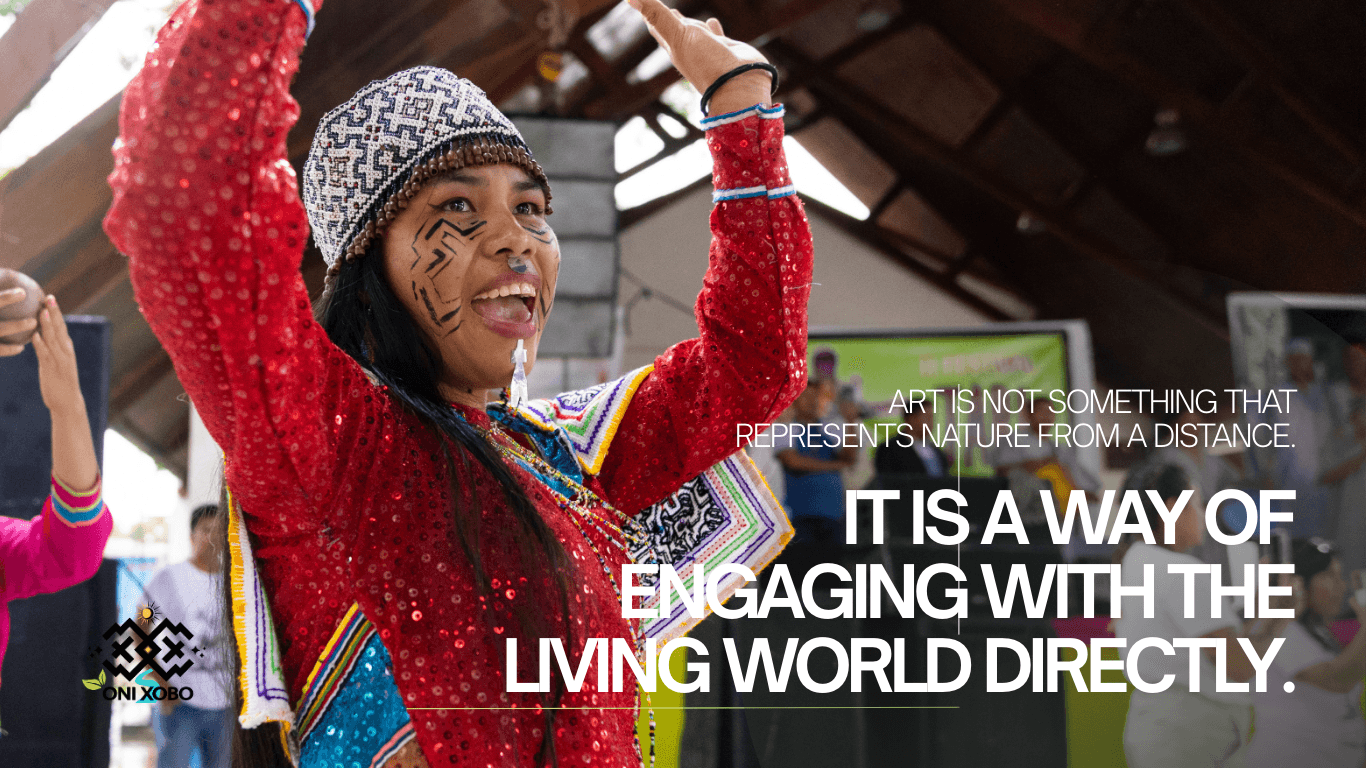
Young Shipibo dancer from Oni Xobo's in-house dance group performing an inter-ethnic dance at Festival Tari in 2024.
It also affirms that Indigenous culture is not static or confined to rural settings. In Yarinacocha, geographically specific traditions are celebrated in an urban environment, reinforcing identity and belonging, while adapting to contemporary realities.
Rather than being a performance for outsiders, Festival Tari centers Indigenous audiences and priorities. In doing so, it sustains the cultural foundations that make long-term care for territory possible.
Oni Xobo has put on the festival twice, in 2023 and 2024, with a growing participation and fan base. The third annual festival was postponed from its 2025 date and will take place in 2026. Oni Xobo is working toward an agreement with the regional government to make the festival a yearly, publicly funded event, where all Indigenous Amazonian cultures — as well as other invited guests from national and international groups — can celebrate their heritage.
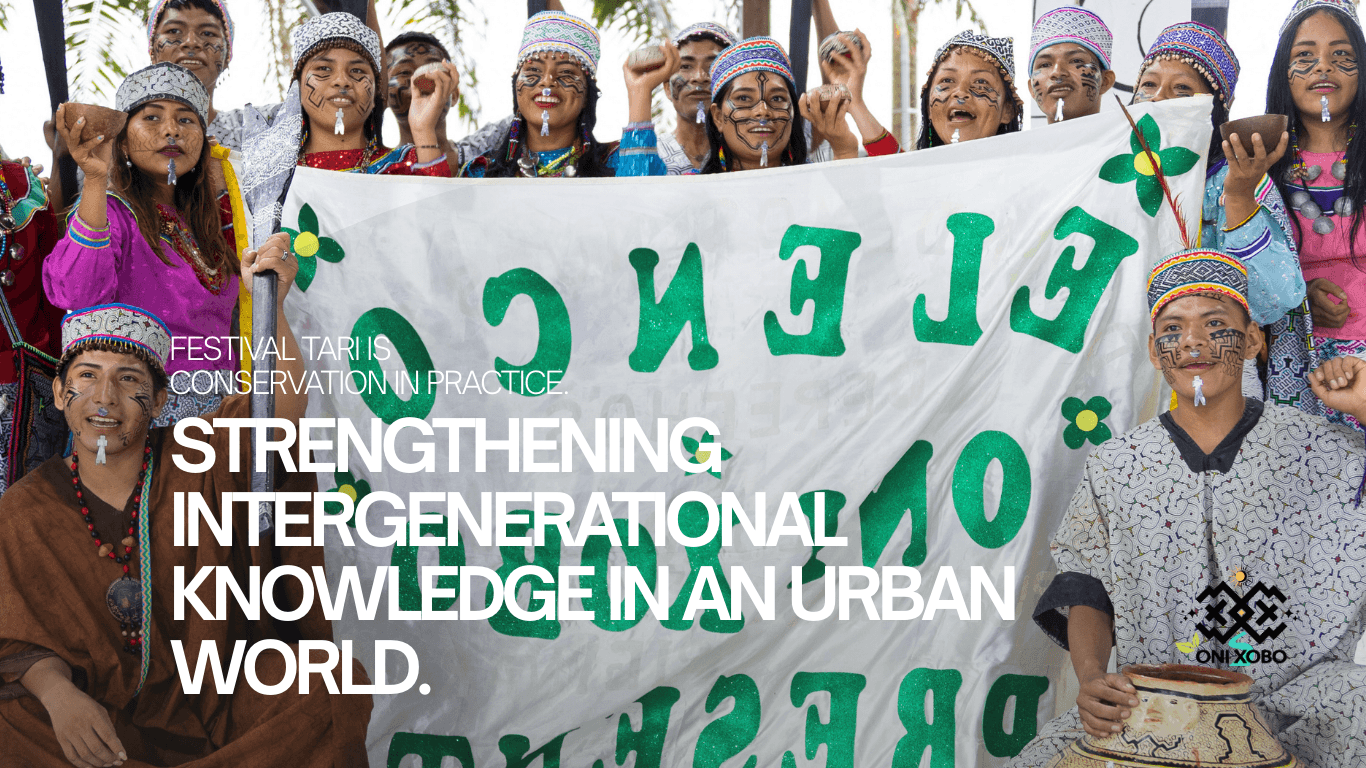
Oni Xobo's full in-house dance group, proud to be participating in Festival Tari as the host dancers, in 2024.
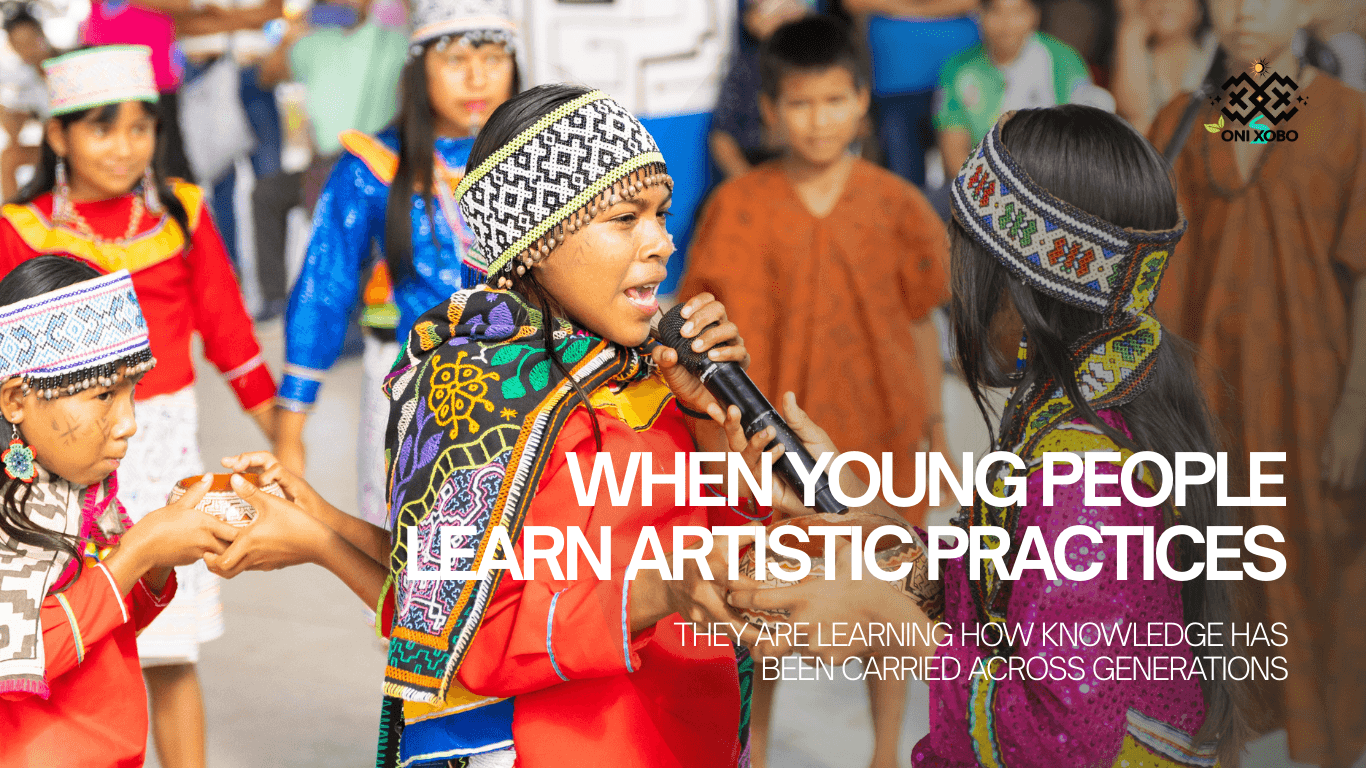
Hermelinda performing as part of the dance group from Nueva Betania in a traditional dance at Festival Tari in 2024.
Professors from the bilingual education system, where Shipibo and other Indigenous youth are taught in their own languages, participate with their dance groups. They express the importance of the space the festival provides, where their ancestral customs are valued, motivating youth to learn and carry forward their expressions.
Festival Tari helps us to continue “revaluing and practicing without leaving our culture behind”, says Jander Ruíz Laulate, a professor and Director of the Primary Bilingual Intercultural Education school in Nueva Betania, a Shipibo community. “The young people follow this and become more interested. This activity makes this possible, we see this enthusiasm in the children, for belonging, learning, and knowing more”.
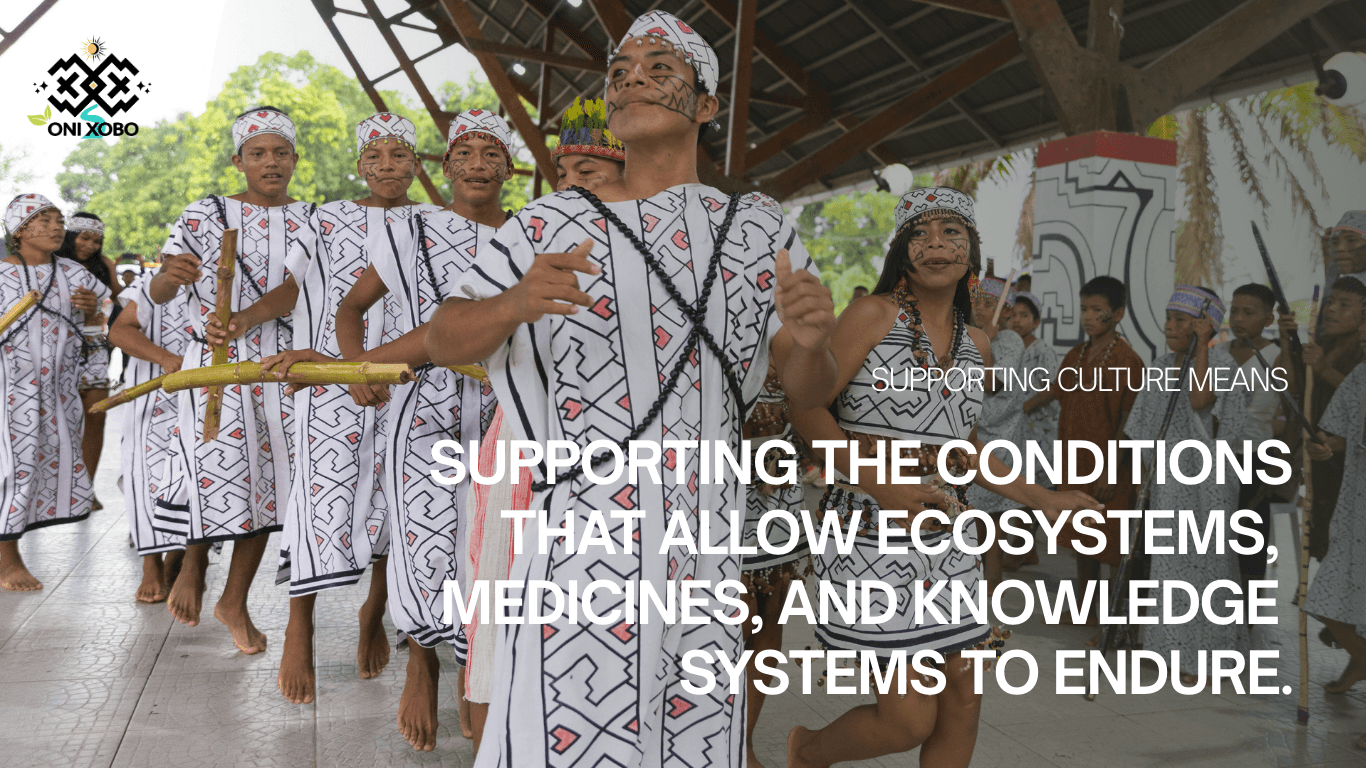
Shipibo dance group from the community of Patria Nueva performing a Yine-styled inter-ethnic dance at Festival Tari in 2024.
IMC Fund’s Perspective
At the Indigenous Medicine Conservation Fund, we support Indigenous-led, spiritually informed biocultural conservation because it reflects how life is actually sustained.
Across the communities we work with, we see that cultural vitality strengthens ecological resilience. Artistic practices are foundational conservation outcomes. Supporting culture means supporting the conditions that allow ecosystems, medicines, and knowledge systems to endure.
The work of Tsuji and Johnson offers a valuable framework for understanding these realities and for articulating them within scientific and policy spaces. And Festival Tari is just one example of many of our partners’ expressions helping connect past to future through art.
Sustaining Cultural Practices, Sustaining Life
As the dancers at Festival Tari move across the stage, they are not reenacting the past. They are practicing continuity.
They remind us that conservation is not only found in laws, plans, or protected areas, but in the everyday acts through which relationships with place are renewed. Song, movement, and creative expression are not separate from care for the land, but among its most enduring forms.
If conservation is ultimately about sustaining life, then it must also sustain the cultural practices through which life has long been understood, honored, and protected.
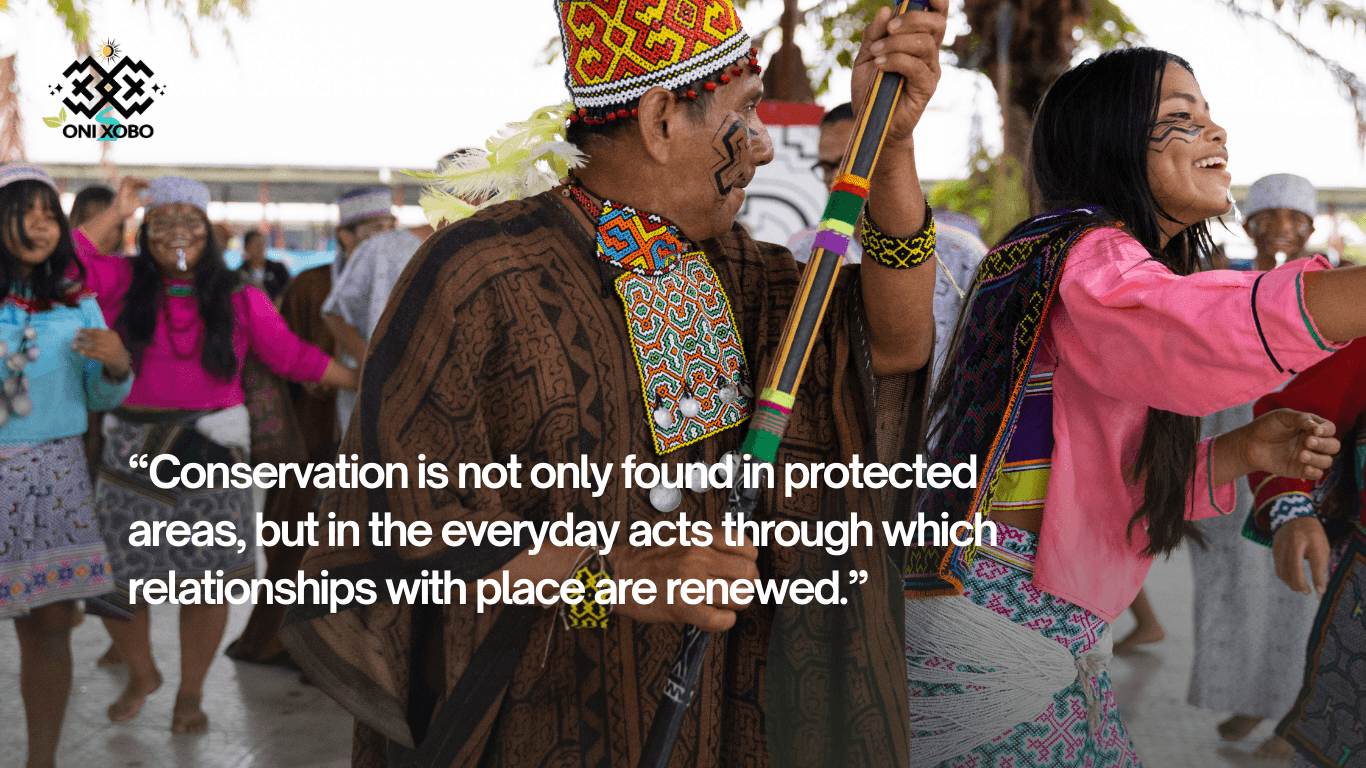
Donaldo Campos and Nikol Sinuiri in part of an inter-ethnic dance performance at Festival Tari in 2024.